Habits
How habits bridge intent and results
We all have goals. As individuals, we may want to be healthier, more productive, or more skilled at our crafts. As a team we want to deliver more, enjoy the process, become more resilient and create more robust products. But there is often a frustrating gap between the “what” (the outcome we want) and the “how” (the actual work required to get there).
I enjoyed reading Atomic Habits by James Clear, and it reinforced a fundamental truth: outcomes are lagging measures of your habits.
Outcomes vs. Actions
In the professional world, we often talk in terms of OKRs. Outcomes are the north star—they tell us where we want to go. However, you cannot actually “invest” your time in an outcome. You cannot “do” a 20% increase in revenue, and you cannot “do” a successful product launch.
You can only invest your time in specific, repeatable actions.
If an OKR is the destination, habits are the vehicle. To bridge the gap between a high-level goal and a tangible result, you must translate that goal into a series of daily practices. When you shift your focus from the goal to the system, the outcome becomes a natural byproduct of your consistency.
Reducing Friction through Routines
One of the most powerful ways to ensure these actions actually happen is by chaining them together into routines.
When we have to make a fresh decision every morning about what to do next, we exhaust our willpower. This is known as “decision fatigue”. By turning actions into routines, we reduce the mental burden required to start. The routine takes over, the “thinking” is done, and the “doing” becomes automatic.
I see this constantly in my professional life. High-performing teams don’t just “hope” to hit their targets; they build reliable, predictable rhythms of work. This is a huge part of how I help teams to deliver things—by focusing on the systems and routines that make delivery inevitable rather than accidental.
Personal Experiments
I try to apply this same logic to my personal life, though I’ll admit with mixed success. I view these not as “rules” to follow, but as experiments in building better systems. Some of the habits I am currently cultivating include:
- Connection: Sending fan mail.
- Mindfulness: Meditating.
- Health: Eating healthy food and eating dinner before 8pm.
- Gratitude: Cultivating feelings of gratitude.
- Environment: Getting outside and cleaning or maintaining something.
- Relax: Playing the piano.
- Growth: Reading books.
- Recover: Being in bed by 11pm.
The Power of Visual Tracking
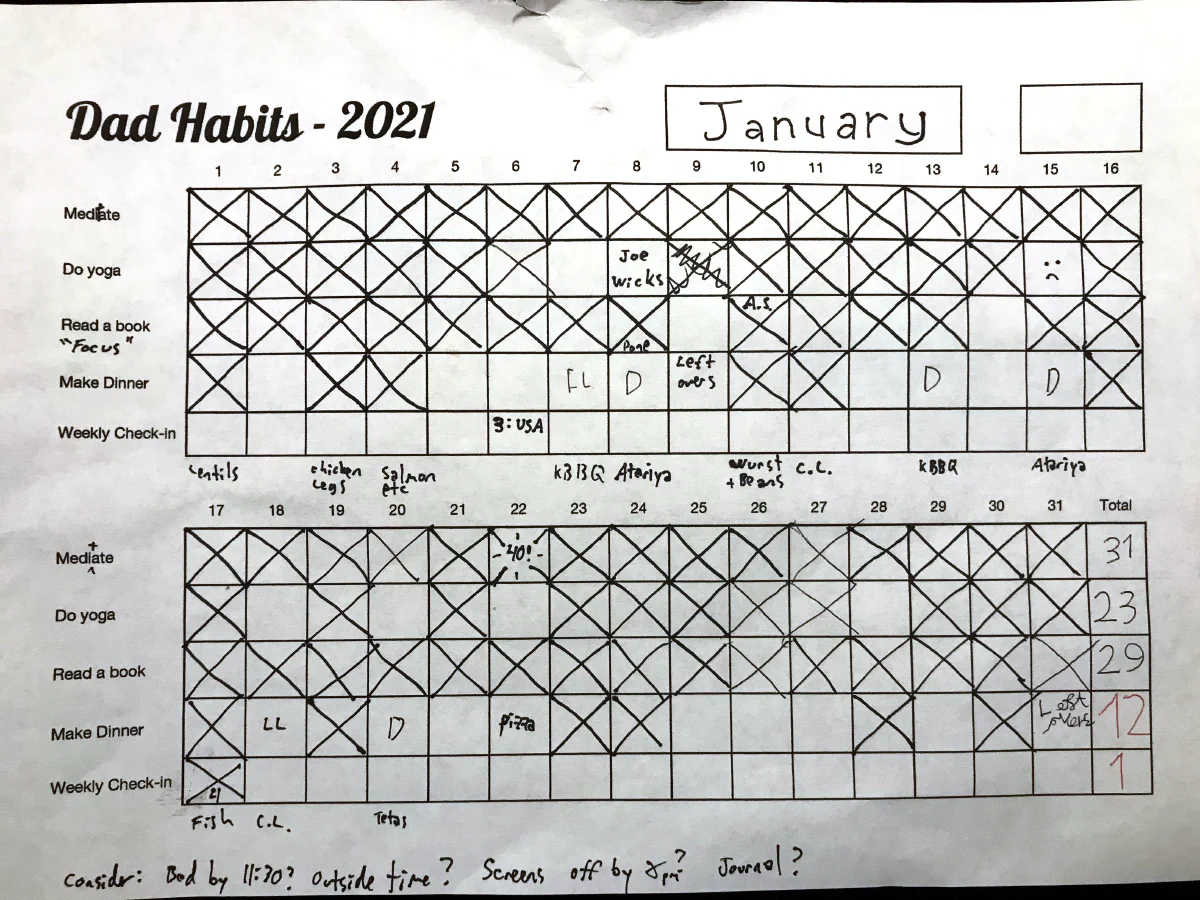
When I am trying to cement a new habit, I rely on the “Don’t break the chain” technique.
The psychology here is two-fold. First, having a visual cue—whether it’s a physical wall chart or a digital spreadsheet—reminds me to perform the action. Second, seeing that “chain” grow provides a small but vital dopamine boost. Missing a day give me a useful kick in the pants: the desire to protect the streak becomes a powerful motivator even on days when motivation is low.
If you’re looking to build your own systems and bridge the gap between your intentions and your results, I built a simple template to help you get started.
I’d love to know more about what habits and routines you use. Get in touch!
About Peter Kappus

With more than 25 years of experience, I use OKRs, agile practices, and more to help teams maximise clarity, delivery, and joy.
Real OKR help
For over 10 years I've offered practical, fun, inclusive OKR training, coaching, and hands-on implementation based around real teams.



Keep in touch
Get my latest ideas and tools straight to your inbox.
Share
Do you know someone who would benefit from my work? Please share!